
CO2 pipelines to benefit from PipeSense’s new leak detection system
Published by Emilie Grant,
Assistant Editor
World Pipelines,
Having proven its capabilities in monitoring and detection leaks in oil and gas pipelines, PipeSense, a leading midstream technology provider, is now expanding its support to emerging CO2 applications and networks.
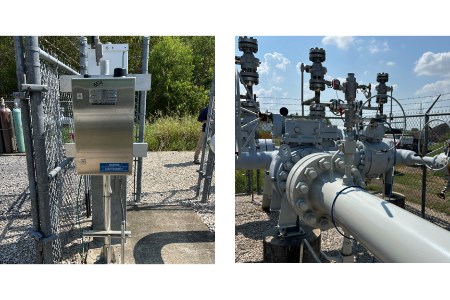
Successfully designing, implementing, and testing a new dynamic pressure analysis-based leak detection system, PipeSense proved the capability of the technology on a South Texas pipeline transporting dense phase and supercritical carbon dioxide (sCO2) at approximately 2000 psi. Deploying its team on-site for testing, PipeSense was responsible for a 12 mile stretch from a compressor station to a client's handoff point within the state.
Applying a Dynamic Pressure Analysis method (DPA), the leak detection system utilised two Field Processing Units (FPU) equipped with high-sensitivity pressure sensors and positioned at each end of the pipeline segment.
Installation commenced in 3Q25, while tests continued throughout 4Q25.
Upon completion of the project, the system capability detects leak events within 2 - 3 minutes and with location precision down to <20 ft. One false positive and zero downtime was observed over a 5 month period, with the system achieving sensitive, accurate detection and addressing key pipeline network challenges like such as speed of sound variability, unplanned compressor station shutdowns and changes between dense and supercritical phases.
Demonstrating the efficacy of a Machine Learning-enhanced Dynamic Pressure Analysis system for leak detection in sCO2 pipelines, the project could prove a crucial milestone for supporting growing demand for Carbon Capture and Storage (CCS) infrastructure. With US CO2 pipelines expected to grow 20 times by 2050, the availability of PipeSense’s technology will help to enhance safety and minimise environmental risks from undetected leaks.
PipeSense’s leadership team is planning for further testing and implementation within CO2 networks and infrastructure in the US and globally.
Stuart Mitchell, President & CTO of PipeSense, commented: “Supercritical CO2 pipelines operate near the critical point, where fluid properties such as density and compressibility exhibit highly nonlinear and rapid variations. Standard Real-Time Transient Models (RTTM) and statistical models, which rely on simplified equations of state and linear assumptions, struggle to accurately predict pressure and flow transients during operational fluctuations. These modeling inaccuracies produce persistent discrepancies that appear as false leak signatures when residuals or pressure anomalies are misinterpreted. Our dynamic pressure analysis method offers a superior, mass-flow-independent alternative, paving the way for reliable monitoring in expanding CCS infrastructure.
The simplicity of our system was on full display during this recent implementation. Through just two FPU connected pressure sensors and a flexible dashboard interface, the system demonstrated its effectiveness and highlighted its potential to scale to larger CCS networks, many of which will be required by the expected growth in CO2 pipelines.”
Read the article online at: https://www.worldpipelines.com/equipment-and-safety/26052026/co-pipelines-to-benefit-from-pipesenses-new-leak-detection-system/
You might also like
The World Pipelines Podcast
A podcast series for energy professionals featuring short, insightful interviews with experts who can shed light on topics that matter to you and your business. Subscribe on your favourite podcast app to start listening today.


