
From clearing to completion
Published by Emilie Grant,
Assistant Editor
World Pipelines,
Amy Olsen, Vermeer Corp., USA, offers a pipeline equipment overview: outlining equipment options for land clearing all the way to project completion.
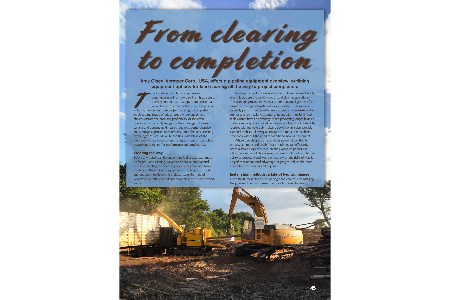
The global demand for energy drives a For larger projects, horizontal grinder, tub grinders and whole continuous need for new pipeline infrastructure, tree chippers are the workhorses of land clearing operations. pushing contractors to adopt more efficient and The selection process between a tub or horizontal grinder often versatile construction methods. For the pipeline hinges on the type of material being processed. Tub grinders industry, the journey from project planning to completion generally perform better with heavy, large-diameter material like involves a multitude of critical steps where equipment choices dictate the pace and profitability of the entire operation. Successfully navigating the challenges of varied terrains and demanding timelines requires a comprehensive and strategic approach to machinery. From the initial clearing of the right-of-way (ROW) to the final installation of the pipe, every phase depends on the deployment of specialised equipment designed for performance and productivity.
Clearing the way
Before any trench can be dug or pipe laid, a clear path must be forged. Land clearing is a labour-intensive but essential first step, creating the necessary access for crews and heavy machinery. The choice of equipment for this task is critical and depends heavily on the project’s scale, the type of vegetation and the desired end-product of the cleared wood waste.
For larger projects, horizontal grinder, tub grinders and whole tree chippers are the workhorses of land clearing operations. The selection process between a tub or horizontal grinder often hinges on the type of material being processed. Tub grinders generally perform better with heavy, large-diameter material like stumps and root balls. Horizontal grinders, with their long feed tables, often have an advantage when processing longer, bushier material more typical in pipeline clearing applications. For remote jobsites with multiple debris piles, track-driven grinders provide essential mobility, allowing an operator to move the machine efficiently without the need for additional towing equipment.
Whole tree chippers offer another powerful solution for processing timber and brush. These machines can efficiently process smaller logs and slash, creating wood chips that can either be sold for additional revenue or redistributed on-site. The ability to process wood waste effectively on the right-of-way is a significant operational advantage, helping to reduce the costs associated with hauling and disposal.
Installation methods: a tale of two techniques
Once the ROW is cleared, crews begin the core task of installing the pipeline. The two primary methods for large-diameter pipeline installation are open-cut trenching and the trenchless method of horizontal directional drilling (HDD). While open-cut trenching remains the standard for the bulk of installation work across open country, HDD has become an indispensable tool for navigating environmentally sensitive areas, waterways, and existing infrastructure.
Trenchers vs excavators: the efficiency equation
In open-cut applications, contractors often default to using excavators, largely because they are a versatile and common fixture in many heavy equipment fleets. However, for large- diameter pipeline installation, particularly in challenging ground conditions like rock and hard clay, specialised trenchers offer significant advantages in efficiency, precision and overall productivity. A trencher operates in one continuous forward movement, whereas an excavator must repeatedly cycle through digging, swinging, and dumping material. This continuous cutting action allows a trencher to work up to three to four times faster than an excavator in many scenarios. Furthermore, trenchers produce a clean, consistent trench with straight sidewalls and a flat, on-grade bottom. This precision reduces the need for extra bedding material and creates a more stable foundation for the pipe. An excavator-dug trench, by contrast, is often wider at the top and may have an uneven bottom, requiring more backfill material and increasing the risk of surface sinking over time.
One of the most significant advantages of a trencher is its ability to handle rock. While an excavator may require a separate hammer attachment to break up rock before scooping it out, a properly configured trencher cuts directly through the rock, producing a finer spoil in the process. This spoil is often suitable for use as backfill, helping to eliminate the need to haul in replacement fill and dispose of large, unusable chunks of rock. A trencher should be viewed not as a replacement for other machines, but as a complementary piece of equipment that enhances the overall efficiency of a jobsite. On many projects, a single large-diameter trencher can outperform as many as four excavators, dramatically accelerating the timeline for open-cut installations.
When to use HDD: the trenchless solution
While trenching is highly effective for long, open stretches, many sections of a pipeline route present obstacles where an open trench is not feasible or permissible. Environmentally sensitive areas, such as river crossings, wetlands, major roadways and railways, require a less invasive approach. This is where contractors use directional drilling.
HDD is a trenchless technology that allows for the installation of pipelines with minimal surface disruption. From a surface launch point, a drill rig bores a pilot hole along a carefully planned subterranean arc, passing beneath the obstacle. The pilot hole is then enlarged in one or more passes by a reamer, creating a borehole large enough to accommodate the product pipe, which is then pulled back through the borehole from the exit point.
A successful HDD operation requires more than just a drill. A complete system of support equipment is necessary. High- pressure mud pumps are vital for circulating the drilling fluid that cools the cutting tools, stabilises the borehole and carries cuttings to the surface. On jobs where large volumes of fluid are pumped each day, reclaimers play a crucial role in reducing jobsite costs and environmental impact by cleaning and recycling this drilling fluid. This support system allows crews to spend more time drilling and less time hauling water and additives, helping to maximise productivity on long and difficult bores.
To access the full version of this article and get a free trial subscription to World Pipelines, sign up here!
Read the article online at: https://www.worldpipelines.com/special-reports/26022026/from-clearing-to-completion/
You might also like
The World Pipelines Podcast
A podcast series for energy professionals featuring short, insightful interviews with experts who can shed light on topics that matter to you and your business. Subscribe on your favourite podcast app to start listening today.


