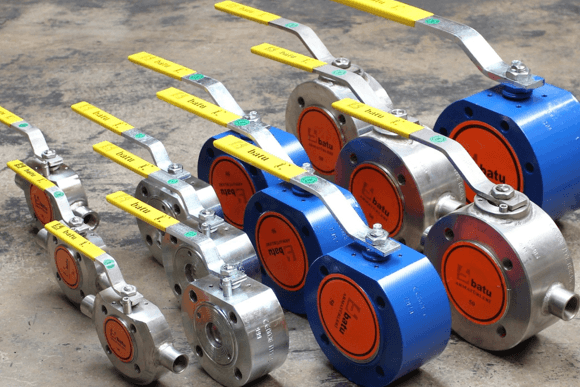
A shorter valve does not necessarily create a smaller or more maintainable station. In LPG and natural-gas packages, actuators, mating connections, vents, bleed points, piping supports and working clearances can occupy far more space than the pressure-containing body. The practical question is not which valve has the shortest face-to-face dimension, but which complete arrangement meets the isolation duty while remaining operable and accessible throughout its service life.
Three different meanings of compact
Component compactness concerns valve length, mass and body geometry. Installed compactness also includes actuators or handles, end interfaces, instrumentation and auxiliary connections. Lifecycle compactness adds access for inspection, bolting, actuator removal, lifting and maintenance. These three envelopes rarely shrink together. For example, a compact body may fit between existing pipe flanges while its lever cannot rotate freely, or its bleed port becomes inaccessible behind neighbouring equipment.
ASME B16.10 provides standardised valve face-to-face and end-to-end dimensions where applicable, but dimensional interchangeability is not the same as station-level suitability.1 Before selecting a replacement, compare the fully assembled configurations on equivalent pressure class, bore, isolation function and operating conditions. Catalogue photographs cannot establish the installed envelope.
Start with the actual installation
A useful comparison begins with the as-built piping geometry and the maintenance task, rather than a preferred valve type. The reviewer should record five groups of requirements:
Face-to-face dimensions, end connections and bolt access.
Lever or actuator sweep, controls and lifting loads.
Access to vent, drain, bleed and instrumentation points.
Seat configuration, isolation and pressure-relief functions.
The clearance needed to inspect, remove or service the assembly. The intended valve orientation and access route must also be checked.
Consider a brownfield gas-metering skid where a shorter monoblock ball valve releases axial room beside a filter. The apparent gain may disappear if the lever hits an enclosure or a future actuator cannot be withdrawn without removing adjacent tubing. This is an illustrative design scenario, not a documented performance result. Accessibility studies in piping design likewise show that visibility, physical reach and practical operability are separate requirements.2
This wider assessment is particularly relevant when one product family offers several end-connection or operator configurations. Lever-operated valves require a usable swing arc and safe operator approach; gear-operated or automated variants introduce different heights, handwheel or motor clearance and future replacement paths. A layout frozen around the bare valve body can therefore become difficult to operate after the final actuator package is selected. The design team should review the largest expected operator envelope before issuing final piping isometrics.
Interfaces and pressure-management duties
A monoblock design may remove a body joint that would exist in some split-body alternatives. That can simplify the assembly, but it does not eliminate pipeline end joints, fittings or maintenance obligations, nor does it demonstrate better leakage performance. Shutoff and pressure-boundary integrity remain separate acceptance questions under applicable valve testing requirements.3 The seat architecture, bleed arrangement and relief path must be verified from the actual drawing, not inferred from a compact exterior.
LPG adds a particularly important constraint. When liquid is trapped between isolation boundaries, warming may produce substantial pressure rise even without leakage. The governing blocked-in volume can extend through connecting pipework and is not represented by valve face-to-face length. Thermal relief, draining and depressurisation provisions therefore require review at system level.4 A short valve in a crowded LPG package is beneficial only if those safeguards and their access remain intact.
A practical selection decision
The section below summarises where compact architecture can help and where a nominal space saving can be lost. It should be completed for each candidate using certified drawings, vendor data, operating requirements and a site survey, not generic percentage-reduction claims.
Restricted axial length
Potential advantage: shorter assembly between interfaces.
Verification needed: actuator or lever sweep and fitting access.
Brownfield replacement
Potential advantage: potentially fewer piping changes.
Verification needed: existing bolts, supports, lifting and maintenance clearance.
Packaged gas skid
Potential advantage: more room around adjacent equipment.
Verification needed: instrumentation, removal path and serviceability.
Liquid-LPG isolation
Potential advantage: compact local footprint.
Verification needed: full trapped volume, relief, vent and drain function.
The appropriate outcome is not always a compact monoblock. A conventional split-body, flanged or trunnion-mounted design may provide better access or a more suitable functional arrangement for a particular size, pressure class or maintenance philosophy. The alternatives must be compared as complete, equivalently qualified assemblies. Required pressure testing, documentation and service-specific verification remain applicable regardless of geometry.3,5
For procurement, the comparison can be recorded as a one-page installed-envelope sheet attached to the technical bid evaluation. It should name the reference duty, show the candidate arrangement in plan and elevation, identify every required operating or maintenance task and mark any unresolved clearance. If an item cannot be verified from a drawing, the decision should be conditional on a site measurement or vendor clarification. This makes the benefit of compactness auditable without claiming that a shorter catalogue dimension automatically delivers a fixed percentage saving in plant footprint or cost.
Conclusion
Compactness delivers engineering value when it reduces the total burden of installation without transferring the problem to access, pressure management or maintenance. For LPG and natural-gas stations, the winning design is the smallest workable isolation arrangement, not simply the shortest valve body. That distinction should be established at the layout stage, checked against the intended maintenance tasks and confirmed before procurement.
References
ASME B16.10:2022, Face-to-Face and End-to-End Dimensions of Valves.
Lee, C.-H., Tsai, M.-H. and Kang, S.-C., “A visual tool for accessibility study of pipeline maintenance during design,” Visualization in Engineering, 2, 6, 2014. DOI: 10.1186/s40327-014-0006-y.
ISO 5208:2015, Industrial valves, Pressure testing of metallic valves.
Ramirez, J.C. et al., “Preventing overpressure hazards from trapped liquids,” Process Safety Progress, 29(4), 313–317, 2010. DOI: 10.1002/prs.10413.
ISO 14313:2025, Oil and gas industries including lower carbon energy, Pipeline transportation systems, Pipeline valves.