
March 2026
The March issue of Hydrocarbon Engineering 2026 opens with Contributing Editor Nancy Yamaguchi’s exploration of how US oil markets have changed over the course of 2025, and how such developments are likely to affect 2026. Further articles offer commentary on catalysts, heat technology, chemical recycling, decarbonisation strategies, digital solutions, AI, and much more.
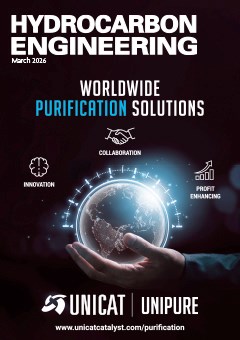
This month's front cover is brought to you by UNICAT.
Register for free »
Get started now for absolutely FREE, no credit card required.
Contents
Comment
Guest comment
News
Order and disorder in US oil markets
Nancy Yamaguchi, Contributing Editor, provides an overview of the changes 2025 brought to the US oil markets, while considering likely developments for the year ahead.
Combating metal contamination
Yali Tang, Luis Murillo, Antoinette Bates, Jeremy Mayol, Jarred Drewry, Xunhua Mo, Marie Goret-Rana, and Mehdi Allahverdi, Johnson Matthey, present a refiner’s guide to effective mitigation of metal contamination in fluid catalytic cracking (FCC) operations.
Unleashing the potential of pyrolysis oil
Nirav Shah, Evonik, presents five steps to unlock the full potential of pyrolysis oil in petrochemical operations.
Assessing the options
Rajendra Gupta and Arun Gautam, KBR, explore polyethylene terephthalate (PET) chemical recycling methods, the challenges to scaling them industrially, and potential solutions.
Closing the loop
Miro Cavkov, Euro Petroleum Consultants (EPC), Bulgaria, explores how different chemical recycling strategies can keep carbon circulating within the industrial value chain, instead of emitting it into the atmosphere.
Cold separation challenges resolved
Sandeep Yadav and Amol Gulhane, Koch-Glitsch, India, explore a field-proven solution to reduce water carryover in cold separators.
Amine corrosion control
Yelena Rojas, Integrated Global Services (IGS), Spain, discusses how operators can extend equipment life and maintain predictable performance in corrosive environments through asset integrity management.
Driving efficiency
Caroline Bird, Solenis, USA, explores how the implementation of monitoring programmes can help improve heat exchanger efficiency within refineries.
A scalable route to a low-carbon future
Nick Rosa and Eric Ludwig, Watlow, USA, explain why medium voltage electrification systems will become a central pillar of industrial decarbonisation strategies.
E-fuels and the future of hydrocarbons
Dr. Alexander Tremel, HIF Global, argues that it is possible to build energy system resilience through synthetic molecules.
Spotting methane super-emitters
Ryan Mattson, GHGSat, considers solutions for oil and gas operators to reduce methane emissions, with emphasis on rapid identification, detection, and response.
From emissions reporting to operational governance
Carlos Ruiz, Nicolás Carrara, and Michelle Wicmandy, KBC (A Yokogawa Company), outline the importance of aligning real-time operations, auditability, and regulatory disclosure in the refining sector.
Smarter plants, stronger performance
Ben Swisher, Emerson, USA, demonstrates how hydrocarbon producers are using digitalisation to find new ways to do more with less.
Industrial AI: from promise to practice
Heiko Petersen and Patrick A. Meade Vargas, ABB’s Energy Industries Division, explore how AI-driven autonomous control is starting to transform process operations.
Establishing a digital backbone
Sean Locke, Hexagon, considers how 3D modelling, digital twins, and AI are rewriting piping design in refineries.
Register for free »
Get started now for absolutely FREE, no credit card required.