The demand for efficient, minimally invasive pipeline installation has put Horizontal Directional Drilling (HDD) at the forefront of modern construction. Ditch Witch, a company known for pioneering underground utility equipment, has been a key player in this evolution. World Pipelines interviews Ditch Witch’s Cory Maker (Senior Product Manager) and Jeff Davis (Product Manager – HDD) to explore HDD trends and the role of digital tools like Orange Intel.
World Pipelines (WP): Improving productivity while minimising costly downtime remains a top priority for contractors working on large-scale pipeline installations, especially in an ever-evolving landscape of underground construction. How do your equipment designs help reduce downtime and increase linear-foot productivity on large-scale pipeline projects?
Ditch Witch (DW): On underground construction projects, productivity comes down to keeping machines running and operators working efficiently. Ditch Witch designs focus on durability, serviceability, and operator-friendly controls that reduce the learning curve and help crews maintain consistent performance over long shifts.
Technologies like Orange Intel telematics give contractors visibility into machine health, utilisation, and maintenance needs across fleets, helping prevent unexpected downtime and improve planning. Features such as software-driven steering functions also help operators maintain productivity when working through difficult ground conditions.
In-house development of machine controls and controllers, allow detailed, real-time equipment data to be captured. This feeds directly into the Orange Intel platform, which provides instant fault code notifications to operators, owners, and dealers.
This proactive approach significantly reduces downtime. Technicians can diagnose issues remotely and arrive on site with the correct parts, avoiding repeat visits and minimising delays.
The platform also supports productivity by identifying operational inefficiencies. By analysing usage data, contractors can address issues such as incorrect operation or unsuitable tooling, helping to optimise performance and increase linear-foot productivity on pipeline projects.

WP: Challenging ground conditions can significantly impact trenching performance and equipment wear. What tooling or attachments do you recommend for trenching through solid rock or highly compacted formations often found along pipeline routes?
DW: Rock and highly compacted soils can dramatically slow trenching productivity, so selecting the right tooling is essential. Contractors often rely on rock saw attachments, carbide or PDC cutting tools and specialised trenching chains designed to withstand abrasive conditions and maintain cutting performance. These tools allow trenchers to maintain progress through hard ground while minimising wear and downtime. When conditions become especially challenging, contractors may also turn to HDD technologies such as All Terrain drilling systems that are specifically designed to navigate rock formations with greater efficiency.
WP: Contractors face growing pressure to minimise disruption while maintaining accuracy. HDD plays a key role in navigating obstacles, and selecting the right system depends on project scale, ground conditions, and technical requirements. Which HDD systems are most suitable for pipeline crossings under roads, rivers, or environmentally sensitive areas, (and what are their typical bore length and diameter limits)?
DW: When it comes to selecting the right HDD system for crossings under roads, rivers, and other sensitive areas, equipment size and capability play a crucial role. The market is broadly divided between smaller ‘mini’ HDD rigs and much larger ‘maxi’ systems traditionally used for heavy-duty pipeline work.
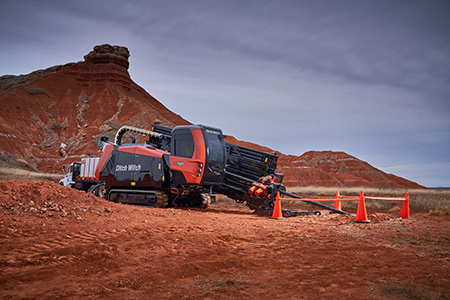
However, this distinction is beginning to shift. Mid-sized, high-capability rigs – including the company’s ATJT120 – are increasingly being adopted for applications that once required significantly larger machines. These units offer a strong balance between performance and practicality.
One of the key advantages is their reduced footprint. Compared to large maxi rigs, which require extensive site setup and space, more compact systems like the ATJT120 and ATJT60 can operate efficiently on smaller job sites, helping contractors lower mobilisation costs and minimise disruption.
In terms of capability, these rigs are proving highly effective on pipeline crossings worldwide. Typical bore lengths of 1000 - 2000 ft are now routinely achieved, along with installations of larger-diameter products, including 24 in. pipelines. This combination of range, power, and efficiency is making mid-sized HDD systems an increasingly attractive option for complex crossing projects.
WP: For contractors working on long-term pipeline projects, controlling total cost of ownership is just as important as upfront equipment performance. What maintenance practices, service intervals, or component designs help lower total cost of ownership for contractors working on multi-year pipeline projects?
Reducing total cost of ownership relies on a structured approach to maintenance and strong support in the field. We provided clearly defined service schedules across our equipment range, helping contractors plan maintenance more effectively.
This is supported by a global dealer network that works closely with factory service teams to deliver service kits, set service intervals, and provide uptime-focused solutions. Together, these efforts help contractors maintain equipment efficiently, minimise downtime, and ensure reliable performance over long-term pipeline projects.
WP: As digitalisation continues to reshape the construction sector, pipeline contractors are placing greater emphasis on data-driven decision-making to improve efficiency and control costs. Telematics and fleet management systems are playing an increasingly important role in this. Do your machines integrate with telematics or fleet management systems to help pipeline contractors track usage, fuel efficiency, and preventative maintenance?
DW: Telematics has evolved well beyond its original role as a maintenance and tracking tool. For Ditch Witch, platforms like Orange Intel now deliver a broad range of performance and productivity insights.
Modern machines can generate extensive data covering everything from fuel efficiency to operational performance. While these remain important, they are now considered baseline capabilities, with contractors increasingly using data in more advanced ways.
On certain projects, particularly in Europe and the US, detailed machine data is essential – they require all of the data coming from that machine to be submitted so they can get paid for their work. This allows contractors to support claims around ground conditions with clear, data-backed evidence.
In addition, the platform supports return on investment (ROI) analysis by combining drilling distance, fuel usage, and other key metrics. Customisable dashboards and improved data visualisation tools make it easier for users to interpret performance, replacing raw data with clear, actionable insights that help optimise jobsite efficiency.
WP: In a highly competitive and evolving industry, contractor feedback plays a critical role in shaping equipment design and innovation. How has feedback from contractors influenced recent design improvements or new product development?
DW: Feedback from contractors plays a major role in how equipment evolves. Operators consistently emphasise the need for machines that are easier to operate, easier to service and capable of maintaining productivity across long workdays. That input has influenced everything from ergonomic operator stations and automated features to telematics systems that provide deeper insights into machine performance. Ultimately, those improvements are focused on helping contractors keep crews productive and projects on schedule in demanding field conditions.
If you found this interview with Ditch Witch insightful, make sure to keep an eye out for their upcoming articles in the April and July issues of World Pipelines.
You can sign up for your FREE copy of the magazine here.