STATS Group’s BISEP provides verified, leak-tight double block and bleed pipeline isolation through a single hot tap intervention. Its independently tested seals and monitored zero-energy zone improve safety, maintain operational continuity, and reduce emissions. Proven across hydrocarbons, hydrogen, CO2, and subsea applications, BISEP sets a benchmark for modern pipeline hot tapping and line stopping worldwide.
Pipeline operators face a familiar challenge, how to complete essential repair, maintenance and modification work without compromising safety, interrupting supply or releasing valuable product. STATS Group’s BISEP® has established itself as the market-leading hot tap deployed line-stopping technology by providing a fully testable, leak-tight double block and bleed isolation through a single hot tap intervention. The BISEP uses two hydraulically activated elastomer seals with a monitored annulus between them, creating a verified zero-energy zone before containment is broken.
The spherical plugging head is deployed into a flowing pressurised pipeline through a single full-bore hot tap fitting or mechanical clamp. Each seal is then independently tested with full pipeline pressure, the pressure trapped in the seal annulus is then vented. The zero-energy zone of the annulus is then continuously monitored to confirm isolation integrity throughout the work scope, any change in pressure would quickly be identified, alerting the operator to an integrity issue with the seals. Once both seals are tested and leak-tight isolation is confirmed, an isolation certificate is issued by STATS to the operator, indicating safe worksite conditions for breaking of containment or hot works to commence. Pipeline pressure acting on the pressure head maintains seal compression independently of the hydraulic activation system, providing an important fail-safe feature. In the event the hydraulic system is compromised the seals would remain activated.
An integrated bypass can maintain flow while the isolated section is repaired or modified, helping operators avoid a full shutdown and reducing project complexity by limiting the number of fittings and hot tapping required.
That capability is backed by an extensive global track record across onshore pipelines, process facilities, offshore topsides, and subsea pipelines. Available for pipeline diameters from 3 - 56 in. and pressures up to 153 bar (2220 psi), the DNV Type Approved system has supported applications ranging from valve replacement and sectional repair to tie-ins, rerouting, and decommissioning. Its origins include a major North Sea topsides campaign on the Brent Bravo and Delta platforms, where hot tap installed double block and bleed isolation enabled the replacement of multiple utility lines. Since then, BISEP deployments have expanded across Europe, North America, the Middle East, and Asia-Pacific, giving operators a proven alternative where shutdowns, depressurisation or conventional line stopping would impose greater cost and risk.
The same approach is increasingly important as the pipeline industry works to reduce operational emissions. Traditional maintenance may require long pipeline sections to be depressurised, with gas vented or flared before work can begin. By establishing a localised, leak-tight isolation close to the worksite, BISEP can greatly reduce or eliminate the inventory that must be released. Where a bypass is used, production or supply can continue while the intervention is completed. For large gas systems, avoiding the depressurisation of extensive pipeline sections can prevent substantial methane emissions, ensure security of supply and shorten maintenance activities.
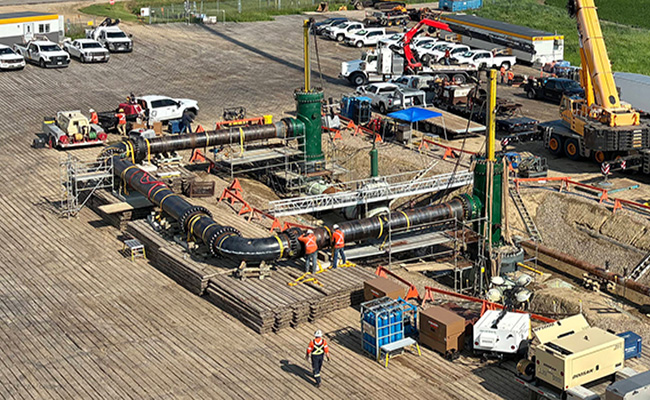
Dual 48in BISEP and Bypass, Canada
BISEP is also supporting the industry’s transition towards lower-carbon energy systems. The technology has been validated and deployed in 100% high-pressure hydrogen service, including the live isolation of an 18 in. pipeline during the UK’s LTS Futures programme. It also has an established record on high-pressure liquid and dense-phase CO2 pipelines in the US, including 30 in. pipelines operating at pressures above 150 bar. These applications present distinct challenges, from hydrogen’s small molecule size to CO2 phase change behaviour, and material compatibility. Proven leak-tight isolation provides operators with greater confidence when modifying existing networks or developing the transport infrastructure required for hydrogen and carbon capture and storage.
Subsea applications extend that assurance to some of the industry’s most demanding environments. The subsea BISEP provides monitored dual barriers for pipeline repair, tie-ins, valve replacement and decommissioning, without the need to take an entire subsea system out of service. Its isolation philosophy supports the principles set out in IMCA D 044 for diver access to subsea systems, while its design satisfies the criteria for DNV Type Approval for Pipeline Isolation Plugs and aligns with DNV-ST-F101 and DNV-RP-F113. Crucially, the independently testable seals and monitored zero-energy zone allow the isolation to be proven before divers break containment and monitored continuously until reinstatement. By combining verified safety barriers, operational continuity and emissions reduction in one system, BISEP is helping define modern best practice for pipeline intervention, from onshore networks and offshore topsides to subsea infrastructure and emerging hydrogen and CO2 infrastructure.
For more information please visit https://www.statsgroup.com/